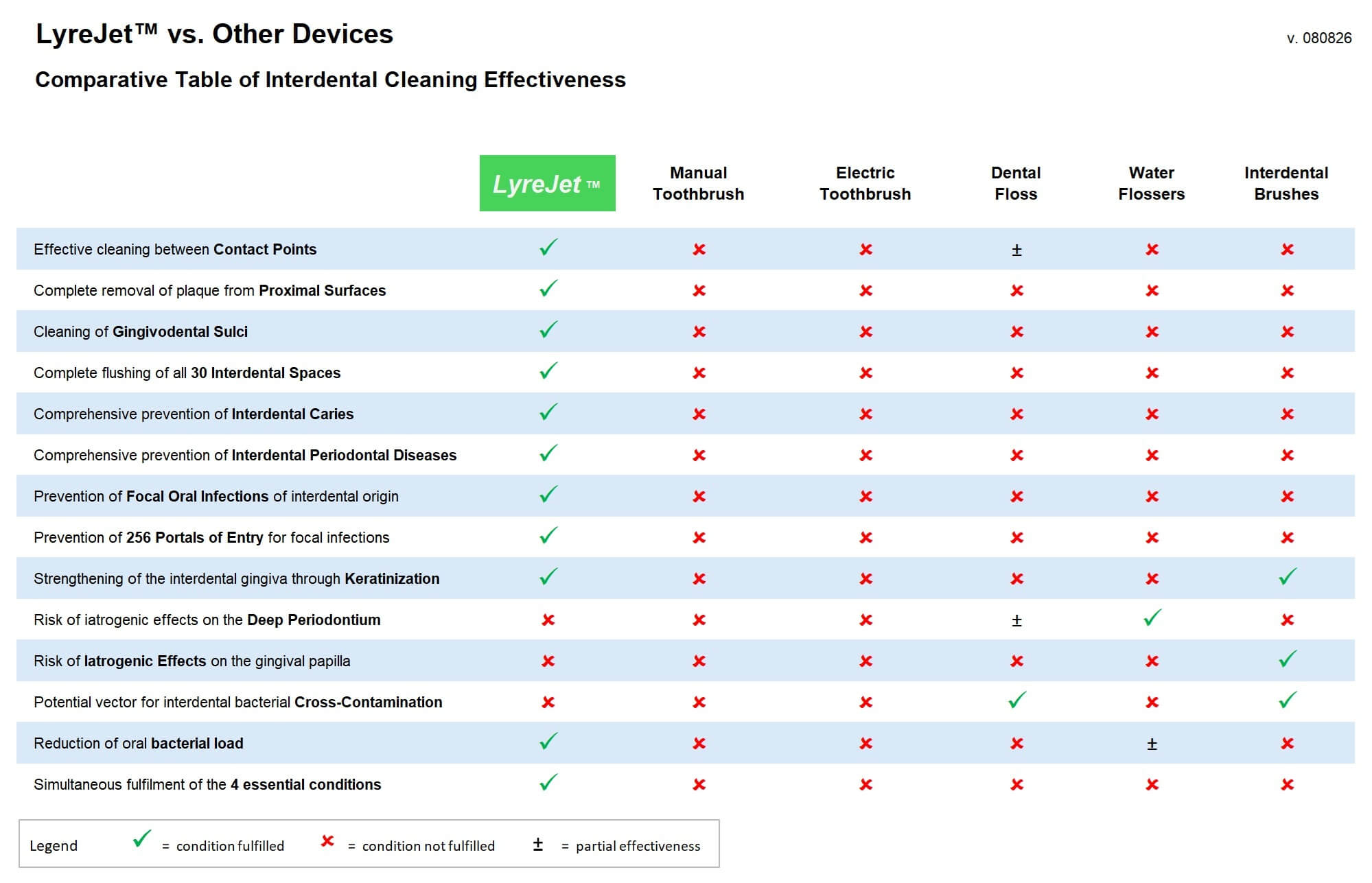



Why Conventional Devices Have Never Achieved Complete Removal of Interdental Bacterial Plaque
For decades, interdental cleaning has been constrained by an anatomical limitation. LyreJet™ was developed to overcome it.
The study of the morphological and biomechanical constraints of interdental spaces shows that no conventional device currently available combines all the conditions required for the complete removal of bacterial plaque. Plaque remains trapped within the anatomical irregularities of interdental spaces, contributing to the development of dental caries, periodontal diseases and focal oral infections.
It was precisely to address this anatomical limitation that LyreJet™ was developed. It is the first technology in the world specifically designed to effectively and easily control the comprehensive cleaning of interdental spaces, whatever their anatomical complexity.
To understand why conventional technologies cannot completely eliminate bacterial plaque, we must first answer a simple question: what conditions must a device meet to thoroughly clean an interdental space?
THE 4 ESSENTIAL CONDITIONS
for the complete removal of interdental bacterial plaque

All four conditions must be met at the same place and at the same time. The absence of even one makes complete removal of interdental plaque impossible and compromises comprehensive oral health prevention.
1
PASS THROUGH THE CONTACT POINTS
to specifically clean them and gain access to the core of the interdental spaces
2
SYSTEMATICALLY AND EASILY REACH THE CORE OF ALL 30 TUNNELS
regardless of their shape, depth or position within the dental arches, in order to precisely clean, without exception, the 6 critical zones that define them
3
PHYSICALLY SCRUB THE 2 CONVEX PROXIMAL SURFACES
to disrupt and detach strongly adherent bacterial biofilm
4
SIMULTANEOUSLY FLUSH AND EVACUATE THE BIOFILM FROM THE TUNNELS
before it can redeposit on the teeth and gingiva
Why Toothbrushes Cannot Enter the Interdental Tunnels
Interdental tunnels are inaccessible to toothbrushes
Manual or electric, toothbrushes cannot pass through the contact points or reach the core of the interdental spaces.
Because they meet none of the 4 essential conditions, interdental spaces are never fully cleaned, and most of the bacterial plaque remains in the most critical areas.
Toothbrushes therefore cannot provide comprehensive prevention of dental caries, periodontal diseases or focal oral infections.
LyreJet™ cleans where toothbrushes cannot reach
● Why do toothbrushes clean only 3 of the 5 surfaces of a tooth?
Manual or electric, toothbrushes clean the visible surfaces of each tooth — essentially 3 of the 5 surfaces. Their size prevents them from reaching the core of the interdental spaces (or “interdental tunnels”), whose width ranges from a few tenths of a millimetre to several millimetres and may even become zero at the contact point. The two proximal surfaces between adjacent teeth therefore remain beyond the reach of the toothbrush bristles.
● Why does 63% of dental plaque escape toothbrushing?
The 3 visible surfaces of the teeth retain only about 37% of bacterial plaque.
The remaining 63% accumulates hidden between the teeth, within the interdental tunnels, which are inaccessible to toothbrush bristles. This means that the majority of bacterial plaque accumulates between the teeth.
● Anatomical explanation of the contact point
The contact point is the precise location where two adjacent teeth touch. At this level, the proximal surfaces converge until they meet, reducing the width of the interdental tunnel to zero millimetres, except in the presence of a diastema.
The contact point acts like a natural trap where food debris can become lodged and bacteria can accumulate. Cleaning this area is particularly important because it is one of the sites most susceptible to the development of interdental caries, sometimes referred to as “between-teeth cavities” when they affect both adjacent teeth.
Why Dental Floss Passes Through and Dislodges Plaque but Cannot Remove It from the Interdental Tunnels
Simply Passing Floss Mechanically Between the Teeth Is Not Enough
Inside interdental tunnels that can be up to 9 mm long, dental floss “scrubs” the plaque without being able to completely remove it from the tunnel.
Because essential condition No. 4 — flushing and evacuation — is not fulfilled, bacteria can continue to proliferate, making comprehensive prevention of dental caries, gingivitis, periodontal diseases and focal oral infections impossible.
LyreJet™ evacuates bacterial plaque from the interdental tunnels
Dental floss – used alone – can only move plaque between the teeth without being able to remove it. Modelled at true anatomical dimensions, conforming to human dental anatomy.
The limitations of dental floss
Passing dental floss between two teeth is like trying to empty a jar of honey with a skewer. The skewer passes through the jar… but when you pull it back out, it removes only a very small amount. The floss simply displaces the honey before everything closes up again behind it.
The same principle applies to interdental bacterial biofilm: the floss passes through and disrupts the plaque, but without a genuine flushing mechanism, the majority of the biofilm remains inside the interdental tunnel. More precisely:
● after the floss has passed, the plaque that has not been evacuated immediately redeposits on the proximal surfaces ②&⑦, on the papillary gingiva ⑤ , and in the gingival sulci ③&⑥
● the vertical movement of the floss detaches, fragments and pushes the biofilm along the teeth, causing bacterial accumulation towards the subgingival areas;
● as the floss exits the interdental spaces, it redeposits plaque beneath the contact point, contributing to the development of interdental caries affecting adjacent teeth;
● as it becomes loaded with bacteria, dental floss may act as a potential vector for cross-contamination between healthy and pathological sites;
● whether used as conventional floss or on a floss pick, its limited ergonomics make access to posterior areas particularly difficult and inconsistent.
Conclusion:
Without a genuine mechanism for flushing and evacuating biofilm from the interdental tunnels, complete interdental decontamination cannot be achieved by dental floss alone. The bacterial burden therefore remains largely present, helping explain why dental problems can continue despite its use.
Why Water Jets Do Not Remove Interdental Plaque
Water flossers deform plaque on the surface without being able to detach it.
Modelled at true anatomical dimensions, conforming to human dental anatomy.
Water Alone Is Not Enough to Detach Adherent Bacterial Biofilm
To detach bacterial plaque, it must first be physically scrubbed before it can be flushed away.
Conventional water jets do not provide this essential mechanical scrubbing action.
Because essential conditions No. 1 and No. 3 are not fulfilled, comprehensive prevention of dental caries, periodontal diseases and focal oral infections cannot be achieved with these devices.
LyreJet™ mechanically detaches interdental bacterial plaque
and simultaneously evacuates it
Limitations of conventional water jets
● Video-microscopic examination shows that the water pressure produced by these devices deforms the bacterial biofilm at the surface without actually detaching it from the tooth surfaces. With these devices, bacterial plaque therefore remains predominantly confined between the teeth.
Trying to remove strongly adherent interdental plaque with a water jet is like trying to clean a car by spraying it with water: the water wets the surface, but firmly adherent deposits remain in place.
● Note: If hydrodynamic action alone were sufficient to remove bacterial plaque, mechanical toothbrushing would no longer be necessary…
Other limitations
● No effective action on food impaction: Water jets cannot remove food debris that becomes firmly lodged between contact points and may contribute to the development of interdental caries affecting adjacent teeth.
No significant action on established calculus.
● Potential iatrogenic subgingival risks: Paradoxically, although their pressure may be insufficient to detach bacterial plaque, improper use — particularly directing a pressurised jet perpendicularly into the gingival sulcus — may disrupt the sulcular seal and drive bacteria deeper beneath the gingiva into the supporting tissues of the tooth.
Such an iatrogenic effect may contribute to chronic periodontal disease and tooth loss.
Why Interdental Brushes Cannot Universally Access All Interdental Tunnels
Their metal or plastic core prevents them from passing through contact points or being inserted laterally when teeth are tightly spaced or when the intact gingival papilla completely fills the interdental space — particularly in younger patients.
Because they do not fulfil essential conditions No. 1, No. 2 and No. 4, bacteria can continue to proliferate, preventing comprehensive and universal prevention of dental caries, gingivitis, periodontal diseases and focal oral infections.
LyreJet™ cleans, disrupts and simultaneously evacuates plaque from all interdental tunnels
The use of interdental brushes is not universal. They do not consistently penetrate all interdental tunnels and do not clean between contact points.
Limitations of interdental brushes
● Interdental brushes cannot remove firmly impacted food debris or bacteria located precisely between the contact points ① and at the origin of interdental caries affecting adjacent teeth. At this level, the space is reduced to zero except in the presence of a diastema.
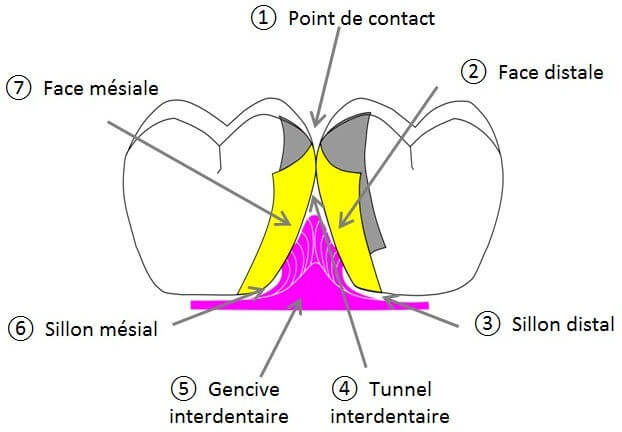
Working “dry”, without a genuine flushing mechanism, they cannot completely evacuate all the bacteria that proliferate within the tunnels.
● Interdental brushes may potentially act as vectors for bacterial cross-contamination when they are transferred from an infected site to a healthy site.
Conclusion
Because they cannot be used in all interdental spaces — particularly when teeth are tightly spaced and/or when the gingival papilla is intact and completely fills the interdental space, especially in younger patients — interdental brushes cannot provide universal and comprehensive primary prevention of dental caries, periodontal diseases and focal oral infections.
Conclusion
Each of the four conventional technologies has its own anatomical limitation. None simultaneously fulfils the four essential conditions required for the complete removal of interdental bacterial plaque defined at the beginning of this page.
LyreJet™ is the solution arising from the anatomical and biomechanical analysis of interdental spaces.
By simultaneously fulfilling all four essential conditions, LyreJet™ creates a genuine biomechanical synergy: each condition reinforces the effectiveness of the others, considerably enhancing cleaning and preventive performance. LyreJet™ therefore provides a simple and remarkably effective solution to a problem that conventional technologies have never been able to address in its entirety.
LyreJet™ excels where all other devices fall short