



LyreJet™ A Historic Breakthrough for Your Oral Health and Overall Health
Because 80% of cavities and Periodontal Disease Begin Between Your Teeth
YOUR 30 INTERDENTAL TUNNELS FORM A MASSIVE CHRONIC BACTERIAL RESERVOIR
Massive and permanent stagnation of bacterial plaque between the teeth, where the toothbrush can never reach. Dimensions conform to human dental anatomy.
THE INVISIBLE PROBLEM
Permanent stagnation of interdental plaque
At every meal, dental plaque forms on all teeth and gums, but especially between the teeth, inside your 30 interdental tunnels, which are particularly difficult to reach.
Because it remains hidden, most people never realize its extent... or its consequences.
What Is Dental Plaque ?
The mouth is the most bacteria-rich cavity of the human body. It hosts a complex ecosystem — the oral microbiome — made up of viruses, fungi and more than 700 bacterial species.
Dental plaque is an aggressive, soft, highly adhesive biofilm formed by the oral microbiome mixed with saliva and food debris.
It forms continuously, at every meal.
MOST DENTAL PLQUE ACCUMULATES BETWEEN THE TEETH
THE INTERDENTAL SPACES
Where most bacterial plaque accumulates
Where conventional cleaning devices have always failed
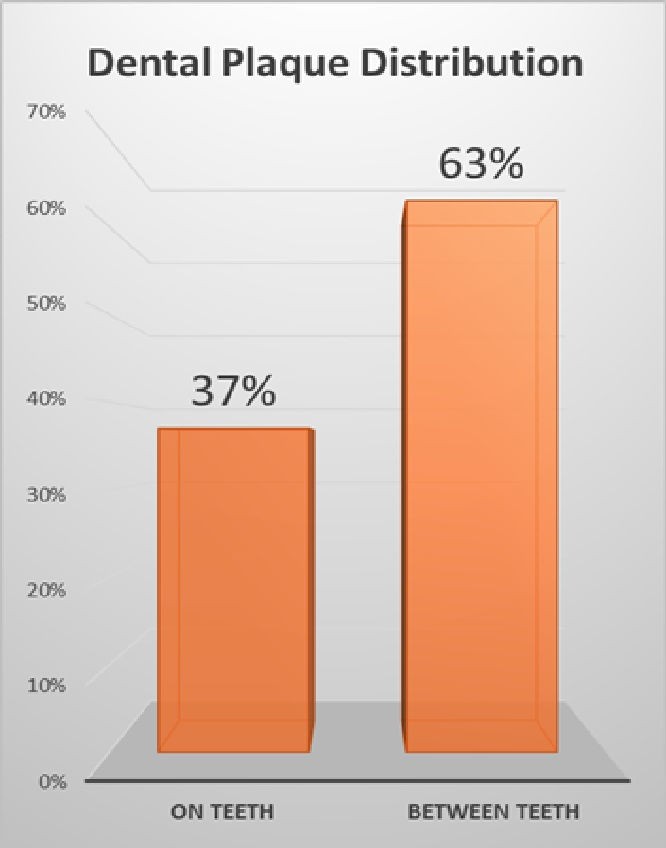
63% of dental plaque accumulates between the teeth, where it remains massively and permanently stagnant, causing the majority of gingivitis, periodontitis and focal infections. In contrast, only a small proportion of plaque (37%) accumulates on the visible surfaces of the teeth and can be removed by toothbrushes.
Why Brushing and Current Devices
Are Not Enough
Have you ever wondered why you still develop cavities, gingivitis, tartar or even periodontitis despite brushing carefully and using dental floss, water flossers or interdental brushes?
The answer is simple: toothbrushing is essential... but it is not enough.
Even the best manual and electric toothbrushes clean only three of the five surfaces of each tooth. They remove only a small portion (37%) of total dental plaque, allowing bacteria to continue multiplying between the teeth.
Before LyreJet™, no conventional device had ever been able to completely eliminate the bacterial plaque that continuously stagnates inside the 30 interdental tunnels, where 63% of all dental plaque accumulates.
It is therefore not surprising that nearly 80% of cavities and periodontal diseases continue to originate there.
This reality also explains the decisive role of interdental diseases in the development of focal infections, which you will discover in the following pages.
D'autre part, avant LyreJet™, aucun dispositif conventionnel n'a jamais réellement permis d’éliminer complètement toute la plaque bactérienne qui stagne en permanence dans vos 30 espaces interdentaires et qui représente pourtant l'essentiel de la plaque dentaire (63%).
Il n'est donc pas étonnant que près de 80 % des caries et des maladies parodontales continuent de s'y développent en permanence.
Cette réalité éclaire également le rôle déterminant des caries et maladies parodontales interdentaires dans l'apparition des "infections focales" graves maladies générales que vous découvrirez dans les pages suivantes.
THE INTERDENTAL TUNNEL
The interdental tunnel in three dimensions. Animation. Modelled at real anatomical dimensions, consistent with human dental anatomy.
THIS IS WHERE MOST CAVITIES AND PERIODONTAL DISEASES BEGIN
Critical anatomical areas for both oral and overall health
An underestimated anatomy with major health consequences
The 6 Anatomical Areas of the Interdental Tunnel
Each tooth has five surfaces:
- three visible surfaces accessible to brushing: lingual, buccal and chewing surfaces;
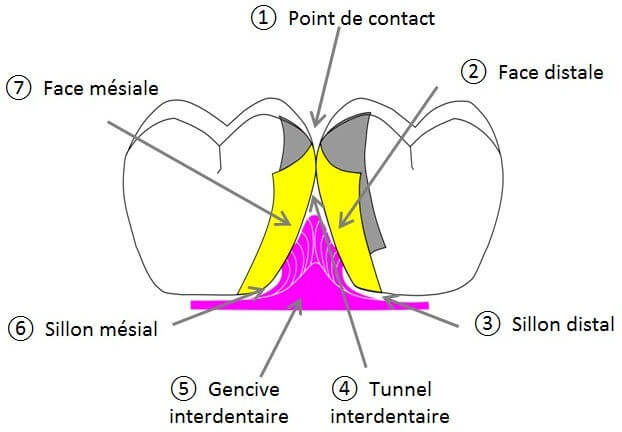
- two invisible proximal surfaces (② and ⑦), inaccessible to toothbrushes (see the anatomical diagram below).
Between two teeth lies the interdental space (④), a tunnel-shaped triangular cavity open at both ends toward the tongue and cheek.
Each interdental tunnel contains six essential anatomical areas that must be thoroughly cleaned:
- two tooth surfaces: mesial (②) and distal (⑦), converging toward the contact point (①);
- the interdental papilla (⑤);
- and two gingival grooves (③ & ⑥), which play a fundamental role in protecting the periodontium. Acting as biological seals around the teeth, they prevent bacteria from penetrating beneath the gum and protect the supporting tissues: periodontal ligament, cementum and alveolar bone.
A GIGANTIC BACTERIAL RESERVOIR THAT HAS NEVER BEEN PROPERLY CLEANED IN THOUSANDS OF YEARS
THE EQUIVALENT OF A 17-CENTIMETER TUBE FILLED WITH BILLIONS OF BACTERIA
The driving force behind the continuous development of most cavities, periodontal diseases and focal infections.
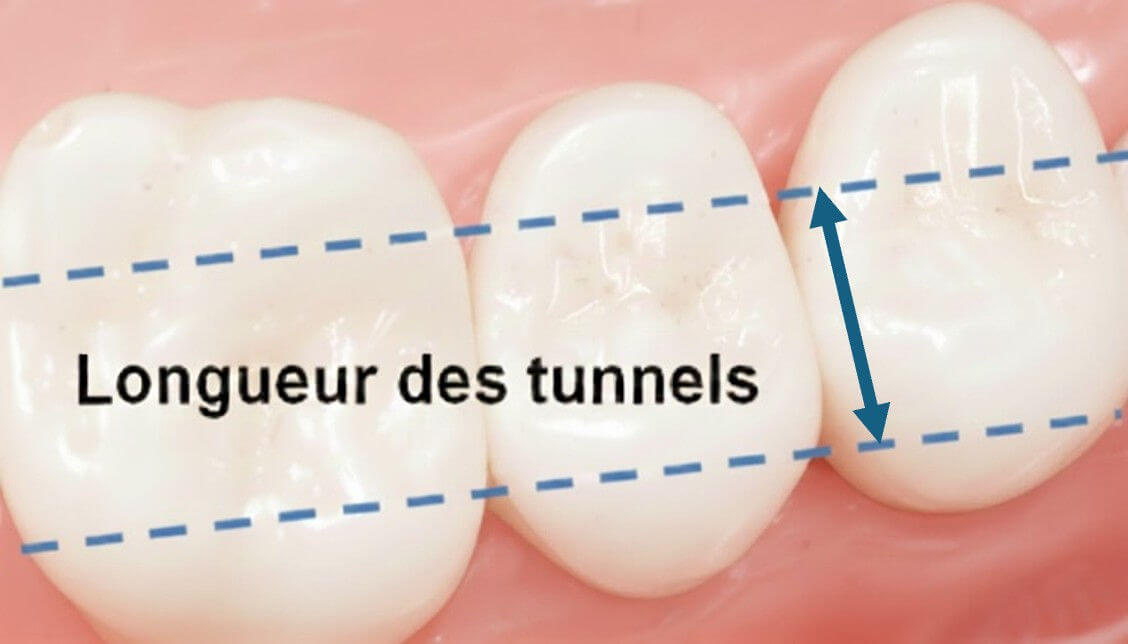
Interdental tunnels can measure up to 9 mm in length. At the scale of bacteria, they constitute gigantic reservoirs in which most (63% and more) of the overall dental plaque accumulates and remains massively and permanently stagnant.
The True Dimensions of the Interdental Tunnels
The width of interdental tunnels ranges from only a few tenths of a millimeter in tightly spaced teeth to several millimeters in wider spaces. Although inaccessible to toothbrushes, their length can exceed 9 mm.
Placed end to end, the 30 interdental tunnels represent the equivalent of a tube nearly 17 centimeters (6.7 inches) long in an adult, continuously filled with bacterial plaque that no conventional device has ever been able to remove completely.
Discover why here.
This permanent accumulation of bacterial plaque explains why dental diseases have persisted throughout history.